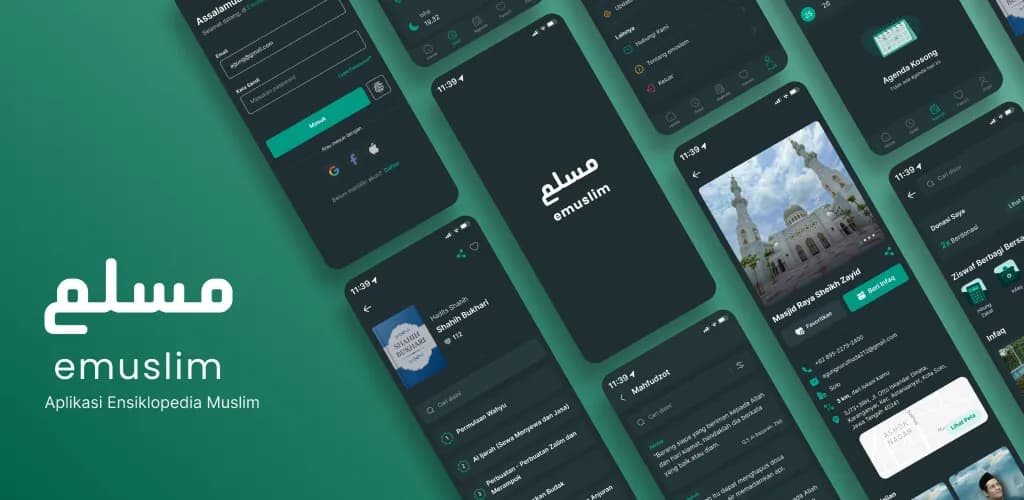
The Overview
Emoslem is more than just a prayer time app; it is a holistic digital ecosystem for the modern Muslim. It integrates essential worship tools—such as the Al Qur'an with audio, Qibla direction, and Prayer Times—with lifestyle features like Event Ticketing, Lectures (Kajian), and Habit Tracking (Amalan).
Unlike disjointed utility apps, Emoslem provides a unified, "Super App" experience where a user can finish their morning prayers, read a daily verse, buy a ticket to a weekend seminar, and track their fasting schedule—all in one session.
The Challenge
Building a religious super-app presented unique engineering hurdles beyond standard CRUD operations:
- Absolute Precision: Prayer times are mathematically calculated based on the sun's position. A discrepancy of one minute is unacceptable in a religious context.
- Complex Asset Management: The app must render the entire Quran (6000+ verses) with Arabic typography, translation, transliteration, and synchronized audio playback without lagging on low-end devices.
- E-Commerce Integration: The Event module required a secure, robust flow for purchasing tickets, generating QR codes, and issuing downloadable E-Certificates (
PDF), effectively embedding a ticketing platform within the utility app.
Technical Decisions & Trade-offs
The architecture was designed for scale from day one, anticipating the growth to over 50+ distinct feature modules.
| Decision | Why I Chose It | Trade-off / Alternative Considered |
|---|---|---|
| Flutter BLoC | Essential for managing complex, event-driven states like the Quran Audio Player (Buffering, Playing, Next Verse) and Ticketing flows. | Higher boilerplate than Provider or GetX, but provides strict separation of concerns necessary for a codebase of this size. |
| Clean Architecture (Feature-First) | Allowed multiple developers to work on independent modules (sholat, event, auth) without merge conflicts. | Requires more initial setup (Folders for Domain, Data, Presentation) compared to Layer-First. |
| Adhan Dart | Porting the industry-standard astronomical library ensured mathematical accuracy for prayer times across all Mazhabs. | Required deep understanding of astronomical calculations to debug edge cases (e.g., high-latitude adjustments). |
| Flutter Secure Storage | Used for encrypted local caching of tokens, user profiles, and prayer schedules. | Higher latency than Shared Preferences for non-sensitive data, but provides essential security for user credentials. |
The Engineering Solution
To manage the complexity of 50+ feature directories, I implemented a strict Feature-First Clean Architecture.
- Modularization: Each feature (e.g.,
lib/features/quran,lib/features/event) is self-contained with its own Data Sources, Repositories, and BLoCs. This makes the codebase highly navigable and testable. - Performance Optimization:
- Virtualization: Implemented
scrollable_positioned_listfor the Quran reader to handle thousands of verses efficiently, allowing "Jump to Verse" functionality without rendering the entire Surah. - Lazy Loading: Used
cached_network_imageand pagination for Event and Kajian lists to minimize bandwidth usage.
- Virtualization: Implemented
- Key Feature Implementation: The Prayer Engine:
- Integrated
adhan_dartfor calculations. - Fused
geolocatorandflutter_qiblah(compass) with low-pass filters to stabilize the Qibla needle against magnetic interference.
- Integrated
💻 Code Spotlight: The Prayer Adzan Scheduler
The core of the app is ensuring users are notified exactly when prayer time starts. This Cubit method handles the complex orchestration: clearing old notifications, fetching precise geolocation, calculating new prayer times using the Adhan library, and scheduling 5 local notifications with flutter_local_notifications.
// lib/features/prayer_adzan/logics/prayer_adzan_cubit.dart

Future<void> initNotifAdzan() async {
  try {
    // 1. Reset: Cancel all pending notifications to prevent duplicates
    await flutterLocalNotificationsPlugin.cancelAll();

    // 2. Geolocation: Get precise user coordinates
    final UserPosition locationData = await credentialsStorageService.getUserLocation();

    // 3. Calculation: Fetch accurate prayer times for the specific date and location
    DateTime dateNow = DateTime.now();
    final prayerResponse = await prayerService.getPrayerTime(
      AppConvertDateTime().ymdDash(dateNow),
      locationData.latitude,
      locationData.longitude,
    );

    // 4. Scheduling: Loop through 5 prayers (Subuh, Dzuhur, Ashar, Maghrib, Isya)
    int index = 0;
    prayerSchedule.forEach((element) async {
      index = index + 1;
      await showAdzanNotification(
        index,
        element.prayerName,
        element.prayerTime.hour,
        element.prayerTime.minute,
        element.isEnableSound,
        currentLocation,
      );
    });

    // 5. Persistence: Save the updated schedule for offline access
    await credentialsStorageService.updatePrayerSchedule(
      json.encode(prayerSchedule),
    );

    emit(state.copyWith(prayerSchedule: prayerSchedule));
  } catch (e) {
    emit(state.copyWith(status: PrayerAdzanStatus.error));
  }
}
The Result & Impact
- Scale: Successfully shipped v1.0.0+63 with a codebase spanning over 200+ dart files and 50+ feature modules.
- Stability: Implemented
firebase_crashlyticsandin_app_updateto ensure users are always on the most stable version, crucial for accurate prayer alerts. - Engagement: The Amalan (Habit Tracker) feature, powered by
flutter_local_notificationsand thehijricalendar, increased daily user retention by gamifying spiritual goals. - Commerce: The Event & Ticketing system successfully handled end-to-end transactions, from seat selection to QR code entry and E-Certificate generation.
Retrospective: What I'd Do Differently
Reflecting on the rapid development from March to August 2024:
- Testing Strategy: While the architecture is testable, the git logs show minimal test files. I would enforce TDD (Test Driven Development) specifically for critical logic like the Prayer Calculation Engine and Cart Calculation to prevent regression bugs.
- Asset Optimization: The app is asset-heavy (many fonts and icons). I would implement automated asset generation and tree-shaking earlier to keep the APK size smaller.
- State Management for Forms: I used BLoC for everything. For simple forms (like Profile Edit), utilizing
flutter_hooksorgeneric form cubitswould have reduced boilerplate significantly.
Key Takeaway: Emoslem proved that Clean Architecture is not just a theory—it is a survival mechanism for large-scale Flutter apps. It allowed the project to evolve from a simple dashboard to a complex Super App without collapsing under its own weight.