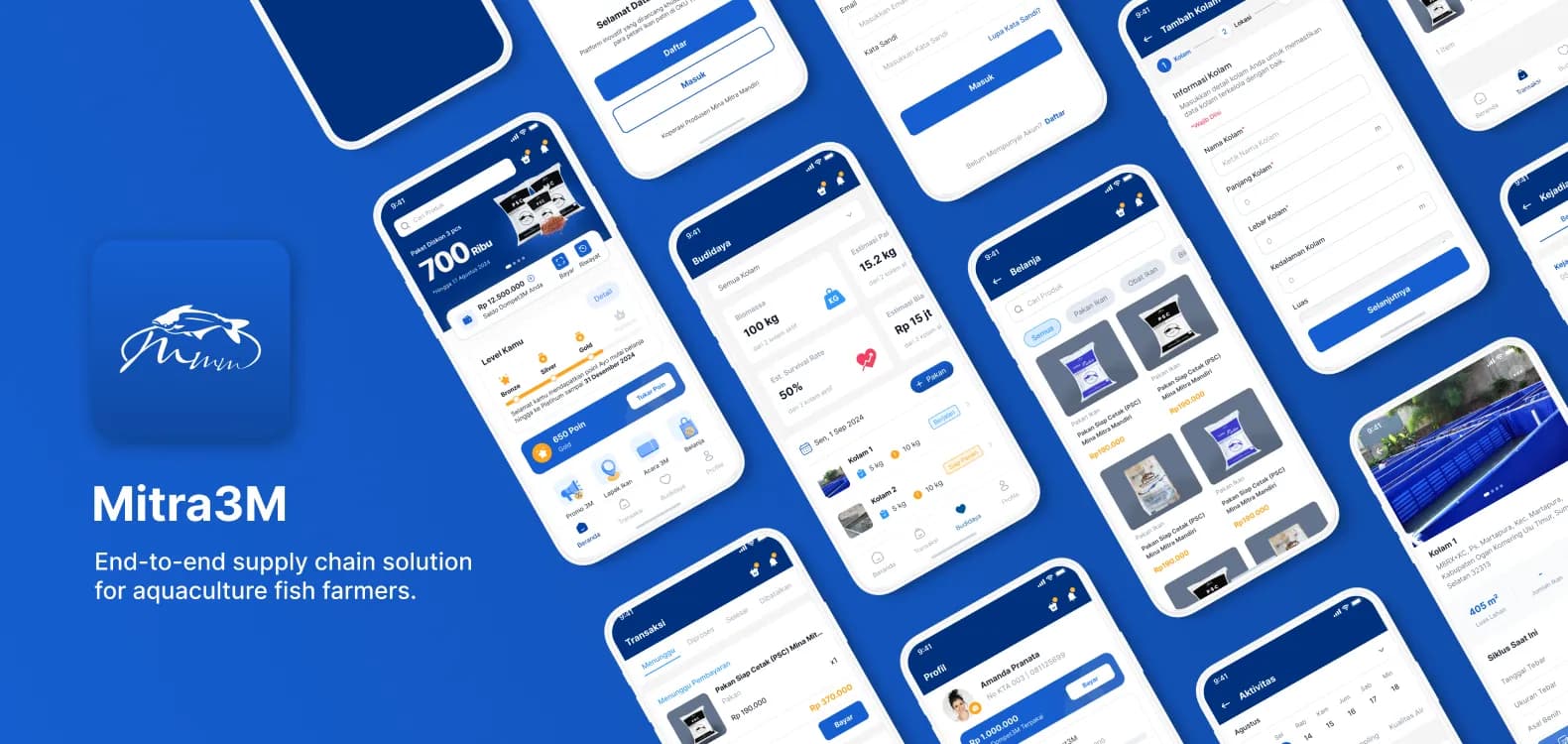
The Overview
Mina Mitra Pembudidaya is a mobile application designed to help fish farmers (pembudidaya) manage their ponds, track cultivation cycles, and optimize yields. Unlike typical record-keeping apps, Mina Mitra integrates a Decision Support System (DSS) based on the Analytical Hierarchy Process (AHP) to assist farmers in making scientific, data-driven decisions regarding feed selection, water quality management, and harvest timing.
The Challenge
The main engineering challenge was building a complex data-collection tool that feels simple and intuitive for users who may not be tech-savvy, often working in remote areas with poor connectivity.
- Constraint: The app must be fully functional offline, syncing data reliably when connectivity is restored.
- Complexity: Implementing the AHP Algorithm directly on the mobile client to provide instant feedback without server round-trips.
Technical Decisions & Trade-offs
Every tool was chosen with a specific purpose. Here is why I chose this stack over others:
| Decision | Why I Chose It | Trade-off / Alternative Considered |
|---|---|---|
| Flutter BLoC (Cubit) | Strict state management was crucial for handling the complex lifecycle of a fish pond (active, harvest, failed). | More boilerplate than Provider, but necessary for the complex state flows of multi-step forms. |
| Dio (Custom Interceptors) | Required robust handling of unstable networks, retries, and token refreshing. | Heavier than standard http package, but the interceptor capabilities were non-negotiable for our auth flow. |
| Client-Side AHP | To provide instant decision support without latency. | Increases app bundle size and logic complexity compared to a server-side calculation. |
The Engineering Solution
To address the challenges, I architected the solution using Clean Architecture to ensure scalability and testability.
- Architecture & Pattern: We utilized a Feature-Driven directory structure combined with BLoC for state management. This allowed us to scale the development team by assigning ownership of specific features (e.g.,
pond,feed,finance) without merge conflicts. - Performance Optimization: Extensive use of Lazy Loading and CachedNetworkImage to ensure the feed of activity logs remains smooth even after thousands of entries.
- Key Feature Implementation: Built a custom Cycle Management Engine that tracks the biological growth curve of the fish based on sampling data to estimate current biomass and FCR (Feed Conversion Ratio).
💻 Code Spotlight: AHP Implementation
Here is a glimpse of how we structured the AHP logic. By abstracting the matrix calculations, we made the decision engine pluggable for different criteria (e.g., Cost vs. Quality vs. Availability).
// Example: Simplified AHP Matrix Calculation Logic
class AhpCalculator {
  /// Calculates the priority vector for a given comparison matrix
  List<double> calculatePriorityVector(Matrix matrix) {
    // 1. Normalize the matrix
    final normalizedMatrix = _normalize(matrix);

    // 2. Calculate row averages (Priority Vector)
    final priorityVector = normalizedMatrix.rows.map((row) {
      return row.reduce((a, b) => a + b) / row.length;
    }).toList();

    return priorityVector;
  }

  // Consistency Check logic would follow...
}
The Result & Impact
- Efficiency: Farmers reported a 20% reduction in feed waste due to better FCR tracking.
- Adoption: Successfully deployed to rural farmers with a high retention rate due to the offline-first capabilities.
- Reliability: The robust error handling architecture ensures that data collected in the field is never lost, even if the app crashes or the battery dies.
Retrospective: What I'd Do Differently
If I were to rebuild this project today, I would improve:
- Local Database: We initially relied heavily on
SharedPreferencesfor simple caching; I would migrate to Drift (SQLite) or Isar earlier to handle the complex relational queries required for cross-cycle reporting. - Form Management: The extensive forms for data entry became hard to maintain; I would adopt a
flutter_form_builderor similar data-driven form generator to reduce boilerplate UI code.
Key Takeaway: This project proved that complex mathematical models (like AHP) can and should live on the client-side when the user experience demands instant interactivity, even in low-resource environments.
Gallery

